
how to start a pet sitting business in the UK
Everything you need to sort out before your first paid visit, and what's worth doing in your first few months. Updated 15 October 2026.
The small print: this guide is general information to help you get started, not legal, tax, insurance or financial advice. Rules differ across the UK and change over time, so check the official pages we link to, or ask a professional, before you rely on anything here. We can't accept responsibility for decisions you make based on it.
On this page:
The short version
To look after pets in their owners' homes, you don't need a licence or a qualification. You will want:
- Insurance, which protects your business if something goes wrong.
- A DBS check, which can reassure customers who are handing you their keys.
- To register as self-employed with HMRC once your takings go over £1,000 in a tax year.
- Written terms that cover cancellations, emergencies and vet bills.
- Prices that pay for your time and your travel, not just what the nearest sitter charges.
The rest of this guide goes through each one, then covers finding customers and keeping on top of the admin.
Do you need a licence?
It comes down to one question: do the pets stay in their own home, or come to stay with you?
The pets stay in their own home: no licence
Drop-in visits, staying over in the owner's home and dog walking don't need a licence in England, because the animals never leave home for your care. That covers most pet sitting businesses.
If you walk dogs, check the rules for the parks you use. Many councils limit how many dogs one person can walk at once, often to four or six, and London's Royal Parks need a permit for commercial dog walkers.
The pets come to stay with you: you need a licence
Looking after cats or dogs in your own home for money is boarding, and in England it needs a licence from your council. That includes dog day care and having a dog to stay overnight at yours, even if it's only one or two at a time. Boarding without a licence can lead to an unlimited fine or up to six months in prison.
Each council sets its own fee and inspects your home before granting one. GOV.UK explains how to apply for a boarding licence and finds your council. Scotland and Wales have their own rules, and boarding needs a licence there too.
Insurance
Insurance isn't a legal requirement for a one-person pet sitting business, but it protects your business if something goes wrong, and it's reassuring for customers to know you have it. Look for a policy written for pet sitters, which usually bundles:
- Public liability: if a pet in your care injures someone or damages their property. £1 million to £5 million is typical.
- Care, custody and control: if a pet is hurt, lost, falls ill or dies while you're looking after it. This is the part that matters most, and limits vary widely, so check it.
- Key cover: replacing lost keys, changing locks and resetting alarms. Changing the locks on a house can easily cost several hundred pounds.
- Non-negligent cover, for when something goes wrong that wasn't your fault, like a dog cutting a paw on glass in the park.
Check the policy covers every animal you'll look after, since some exclude reptiles, horses or poultry, and the most dogs you'll ever walk at once. It's also worth checking your car insurance covers driving between visits.
If other people sit for you
Employers must have employer's liability insurance, by law. Whether you count as their employer depends on how the work happens, not what you call it or whether they're on a payroll. Sitters who are genuinely self-employed, choose which work to take and have their own insurance usually aren't your employees. Someone you tell when, where and how to work may be, even if you pay them as self-employed. GOV.UK explains who counts as an employee, and your insurer can tell you what your policy needs.
Finding a policy
Get two or three quotes before you choose. Some places to start:
- Specialist pet business insurers, such as Protectivity, Cliverton and Pet Business Insurance. Their policies are built around pet sitting and dog walking, so they cover the things above as standard or as add-ons.
- A comparison site, like Quotezone's page for pet workers, to see several insurers at once.
- A membership body. Some NarpsUK memberships include a discount on pet business insurance.
When you compare, look past the price at the care, custody and control limit, whether keys are covered, which services and animals are included, and how much you'd pay towards a claim yourself. We don't have an arrangement with any of these companies.
A DBS check
There's no rule that says you need one, but it can reassure customers who are handing you their keys and letting you into their home while they're away. A basic DBS check shows any unspent criminal convictions. You can apply for your own basic DBS check on GOV.UK. It costs £20 from 5 October 2026 and usually comes back within a couple of weeks.
A basic check is the only level available for pet sitting. If someone tells you that you need an enhanced check, they're mistaken: those are for work with children and vulnerable adults.
Registering with HMRC
Most pet sitters start as sole traders. There's nothing to set up: you're in business once you start taking money. You can turn it into a limited company later if it grows, but talk to an accountant before you do.
What you need to do depends on how much you take in a tax year, which runs from 6 April to 5 April. "Takings" here means everything customers pay you, before your costs.
Up to £1,000: nothing to tell HMRC
The first £1,000 a year from self-employment is tax-free under the trading allowance, and you don't need to register or send a tax return for it. Keep records anyway, so you know when you go over.
Over £1,000: register and send a tax return
- Register as self-employed by 5 October after the tax year ends. If you go over £1,000 at any point between 6 April 2026 and 5 April 2027, register by 5 October 2027. Register for Self Assessment on GOV.UK.
- Send a Self Assessment tax return each year and pay what you owe by 31 January. For the tax year to 5 April 2027, that's 31 January 2028. You pay Income Tax and National Insurance on your profit, which is your takings minus your costs.
Over £20,000: Making Tax Digital
Above a threshold, you'll need to keep your records in approved software and send HMRC an update every three months, as well as your tax return. The threshold counts takings from self-employment and any rental income together:
- Over £30,000 in the tax year to 5 April 2026: from 6 April 2027.
- Over £20,000 in the tax year to 5 April 2027: from 6 April 2028.
GOV.UK has the details of when Making Tax Digital applies to you.
Over £90,000 in any 12 months: VAT
Once your takings over the last 12 months go over £90,000, you need to register for VAT within 30 days of the end of that month. This one is any 12 months in a row, not the tax year, so check it every month once you're getting close.
Whatever you take
Keep a record of every payment you take and every cost you pay from day one. Mileage, insurance, your DBS check, your phone, software and supplies all reduce your tax bill. For mileage, the simplest way is HMRC's flat rate of 55p a mile for a car, recorded with the date and where you went. Keep your records for at least five years after the 31 January deadline for each tax year.
A separate bank account for the business isn't required for a sole trader, but it makes all of this far easier, and many banks don't allow business use of a personal account.
Customers' details
You'll hold customers' names, addresses, phone numbers and how to get into their homes. That's personal information, so the data protection rules apply to you as they do to any business:
- Keep it secure, and only for as long as you need it.
- Most businesses that hold customer details should pay the ICO's data protection fee each year. For a business your size it's around £50. The ICO's self-assessment takes a few minutes and tells you whether you need to.
- Tell customers what you hold and why, in a short privacy notice. It can go on your website or in your terms.
Keys and access
- Never write an address on a key. Label each key with a code, and keep the list of what each code means somewhere else, like your phone.
- Agree how keys are handed over and returned, and write it down. A key safe at the customer's home saves a lot of trips, but get the code by message rather than written down.
- Get alarm codes and instructions before the customer goes away, and try them at the first meeting.
- Check your insurance covers keys, as above.
Your terms
Written terms save you from awkward conversations later. Send them before the first booking and ask the customer to agree to them. They should cover:
- Payment: when it's due, and whether you take a deposit. Most sitters ask for payment before the first visit.
- Cancellations: how much notice you need, and what you keep if a booking is cancelled late. Christmas and the summer holidays often have stricter terms, because you'll have turned other people away.
- Vets: permission to take a pet to the vet in an emergency, which vet, and who pays. Ask the customer to tell their vet you're allowed to authorise treatment.
- If the owner doesn't come home: an emergency contact who can take over, and what happens if their flight's delayed.
- What you will and won't do: medication, cleaning litter trays, bringing in post, watering plants.
Every new customer should start with a free meet-and-greet in their home. You meet the pets, learn the routine, check the keys and alarm, and find out whether you're a good fit. Some pets aren't, and it's better to find out then.
Setting your prices
Most UK pet sitters charge £11 to £20 for a drop-in visit and £35 to £70 a night to stay over, but don't copy the sitter down the road. Work out what a visit costs you in time, travel and running costs, and charge at least that.
Our guide to how much to charge has typical 2026 prices for every kind of visit, extras like bank holidays and medication, and a calculator that works out your own price.
Finding your first customers
Pet sitting is local and runs on trust, so your first customers will almost always come from people who know you or someone who does.
- A Google Business Profile. It's free, and it's how people searching "cat sitter near me" will find you. Ask every happy customer for a review there.
- Local Facebook groups and Nextdoor. Join, be helpful, and post when you have space. Many groups have a day for business posts.
- Vets, groomers and pet shops. Ask if you can leave cards or put up a notice. Vets are asked for sitter recommendations all the time.
- Neighbours, friends and family. Tell everyone. Your first few customers are most likely to be people who already trust you.
- A simple website, once you're up and running: what you do, the area you cover, your prices, your insurance and DBS check, and how to get in touch.
Marketplaces like Rover will bring you enquiries, but they take a cut and the customer belongs to them. Use them to get going if you need to, and move customers to booking with you directly.
Keeping on top of the admin
Most sitters start with WhatsApp, a notebook and their banking app, and it works for the first few customers. It starts to fall apart when you're busy: a booking agreed in a message never makes it into the diary, a customer forgets to pay and you don't notice for weeks, the notes on which cat needs which food are three screens back in a chat. By the summer holidays you're spending your evenings checking who's paid.
That's exactly where Milly, a cat sitter, found herself. So we built her an app, and every booking she's taken since has gone through it. Now it's ready for other pet sitters.
sitkit, the app for pet sitters
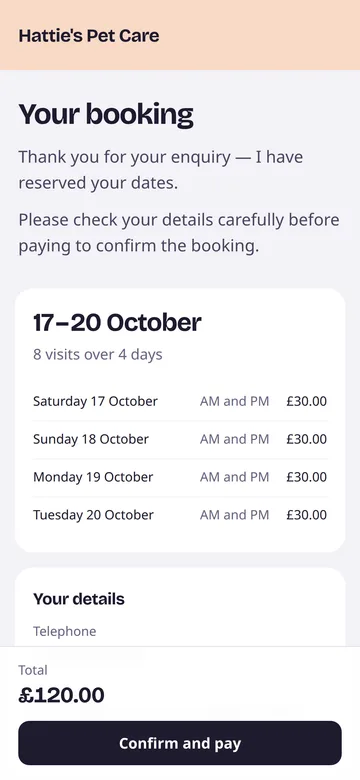
- Add a booking in a minute. Pick the dates, how many visits a day and your price, and every visit is laid out.
- Send your customer a link. They see every visit and the total, and pay by card, Apple Pay or Google Pay. The booking confirms itself, so there's no chasing.
- Every visit in your diary, with the address, directions, the customer's number and your notes, ready on the doorstep.
- See what's not confirmed yet at a glance, and how this year compares with last.
- Nothing for customers to download, and nothing to install for you. It works on any phone.
£15 a month. Cancel any time with 30 days' notice.
Weighing up your options? Our comparison of pet sitting software in the UK sets out what each app costs and who it suits, including when one of the others would suit you better.